

Table of Contents
- Why Single Parents Need a Different Debt Payoff Plan
- 1. The Debt Snowball Method: Quick Wins That Build Momentum
- 2. The Debt Avalanche Method: Save the Most on Interest
- Debt Snowball vs. Debt Avalanche: Which Fits Your Situation?
- 3. How to Prioritize Debt Payments When Money Is Tight
- 4. Building a Debt Payoff Plan on a Tight Budget
- 5. Using a Single Parent Budget Template to Stay on Track
- Frequently Asked Questions
Last Updated: October 18, 2026
Why Single Parents Need a Different Debt Payoff Plan
Debt payoff strategies for single parents have to survive real life: one income, childcare that eats a second income, and a month that never looks the same twice, which is why the debt payoff strategies below are built for that reality.
That changes the math. A plan built for two incomes usually leaves no room for a childcare copay or a school fee that lands without warning.
1. The Debt Snowball Method: Quick Wins That Build Momentum
The debt snowball method is a payoff strategy that ranks debts from smallest balance to largest, regardless of interest rate.
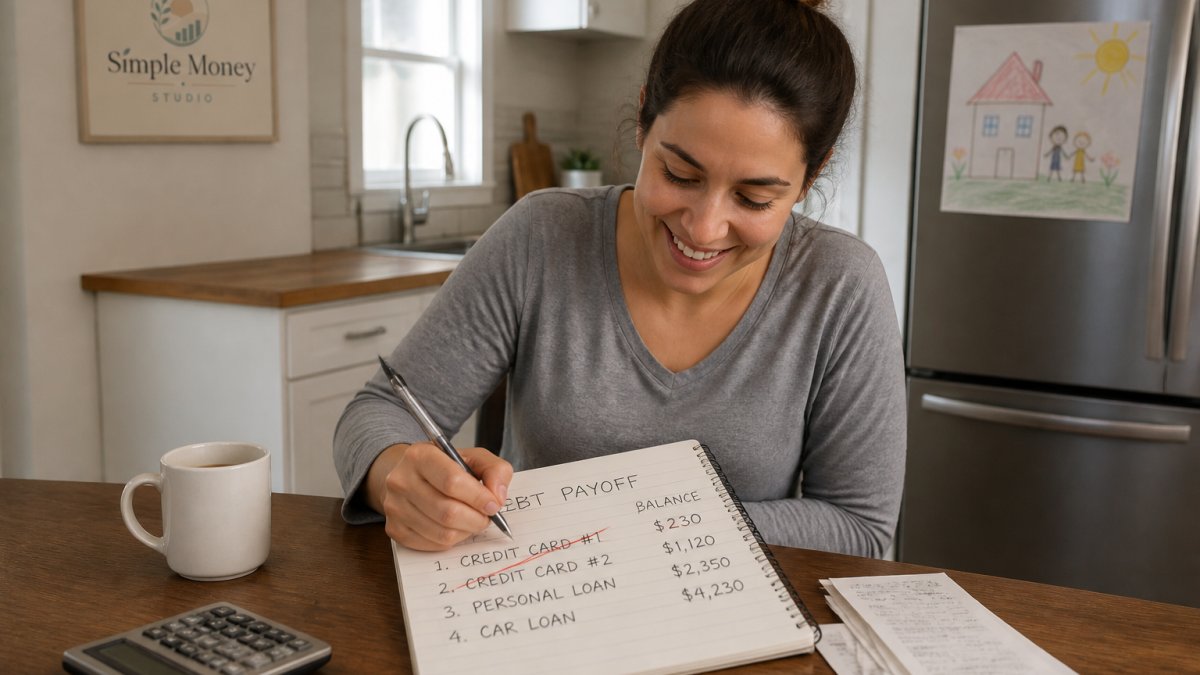
Why it works for single parents: momentum. When your budget is stretched, motivation is the scarce resource, not math.
A typical starting point: three credit cards and a small medical bill. List them smallest to largest, pay minimums on all, and send the extra to the smallest.
2. The Debt Avalanche Method: Save the Most on Interest
The debt avalanche method ranks debts by interest rate instead of balance. You pay minimums on everything and send extra money to the highest-rate debt first, usually a credit card.
This approach costs less over time. High-rate credit card debt compounds against you faster than most people expect, and every month you delay attacking the top rate adds to the total.
For single parents with a stable income and a real emergency cushion, avalanche is the stronger long-term choice.
Debt Snowball vs. Debt Avalanche: Which Fits Your Situation?
Choose snowball if motivation is your weak point and your budget has little slack. Choose avalanche if your income is steady, you have a small cushion, and the highest-rate debt is clearly the most expensive. Here is the comparison in practice:
| Factor | Debt Snowball | Debt Avalanche |
|---|---|---|
| Ranking order | Smallest balance first | Highest interest rate first |
| First win arrives | Fast, often weeks | Slower, often months |
| Interest cost | Higher total | Lower total |
| Best for | Fragile budgets, motivation dips | Stable income, cushion in place |
| Main risk | Paying more interest overall | Quitting before the first win |
A practical middle path: run snowball until you clear one or two small balances, then switch to avalanche with the momentum you have built. The Debt & Savings Tracker from Simple Money Studio includes a Choose Your Payoff Strategy page with space to write your chosen method, why it fits you, and your target debt, so the decision stays visible instead of drifting.

3. How to Prioritize Debt Payments When Money Is Tight
When payments compete with essentials, essentials win. Housing, food, utilities, childcare, transportation to work, and required medications come first. Missing a rent payment to clear a credit card is a bad trade every time.
After essentials, rank debts by consequence rather than balance. A missed secured loan payment can cost you the car you need for work. A credit card late fee stings but rarely threatens your housing. Here is how to order it:
- Secured debts (auto loan, anything tied to an asset you depend on)
- Debts with wage garnishment or legal exposure
- High-interest credit cards
- Medical debt, which often has more flexible payment terms than other debts
- Personal loans and family loans
That ranking is a starting point, not a rule. The real work is deciding what to do when the money left over after essentials will not cover every minimum.
What to say when you call a creditor
If you cannot cover a minimum, call the creditor before the due date. Many lenders offer hardship programs, reduced payments, or a temporary forbearance (What is mortgage forbearance?). Ask specifically for the hardship department, explain the situation in one sentence, and get any agreement in writing. A short script helps:
"I am a single parent and my income changed. I can pay $X per month right now. Can you set up a hardship plan or reduced payment for six months, and can you confirm that in writing?"
Ask three questions on every call: Will this stop late fees? Will it stop interest from accruing? Will it be reported as late to the credit bureaus? The answers change the value of the arrangement. A payment plan that still reports late is worth less than one that does not.
When to let a debt go late on purpose
Sometimes the math forces a choice. If you have $200 left after essentials and $400 in minimums, something will be late. In that case, protect the debts with the worst consequences (secured debt, anything with garnishment risk) and let the lowest-consequence debt go late while you negotiate. Call that creditor first, explain the plan, and ask for a due-date change or a hardship arrangement. A documented call before the due date is very different from silence after it.
4. Building a Debt Payoff Plan on a Tight Budget
A debt payoff plan on a tight budget starts with three numbers: total monthly income, total essential expenses, and total minimum debt payments. Whatever is left is your payoff money, and if nothing is left, the plan is not a payoff problem yet. It is an income or expense problem.
Work through it in this order:
- List every income source with its date, including child support, side work, and tax refunds.
- List every bill and minimum payment with due dates.
- Subtract essentials to find what is actually left.
- Assign the leftover to one target debt, not spread across several.
- Review monthly and adjust when income or bills change.
A worked example on a realistic single-parent budget
Numbers make this concrete. Here is a simplified monthly picture for a single parent with one child, using round figures for illustration:
| Line item | Amount |
|---|---|
| Take-home pay | $3,200 |
| Child support received | $400 |
| Total income | $3,600 |
| Rent | $1,150 |
| Utilities | $180 |
| Groceries | $450 |
| Childcare | $600 |
| Car payment | $310 |
| Gas and insurance | $160 |
| Phone | $70 |
| Total essentials | $2,920 |
| Minimum debt payments (two cards, one medical) | $260 |
| Left for extra payoff | $420 |
In this example, $420 is the payoff money. Under snowball, that $420 goes to the smallest balance until it clears, then rolls onto the next. Under avalanche, it goes to the highest-rate card. The point of the table is not the exact numbers.
Now change one line. If childcare rises to $750, the leftover drops to $270. If a car repair lands in the same month, it can disappear entirely. That is why the plan needs a buffer line, not just a payoff line.
Handling irregular income and child support
Irregular income needs a different rhythm. If child support or gig work arrives unevenly, budget on your lowest reliable month and treat extra income as a bonus payment. Two habits help:
- Budget on the floor, not the average. Build the plan around the smallest month you expect, so a short month does not force a missed payment.
- Send windfalls straight to the target debt. A tax refund, a bonus, or an extra shift is payoff money, not spending money. Directing a refund to one balance can clear it outright.
Tax refunds are the single biggest payoff opportunity most single parents have. If you expect a refund, decide before it arrives which balance it will clear, and consider adjusting withholding so you are not lending the government money interest-free all year. The Consumer Financial Protection Bureau's debt management guide is a solid free reference for understanding your rights and options before you commit to a plan.
5. Using a Single Parent Budget Template to Stay on Track
A single parent budget template is a printable or digital worksheet that tracks income, bills, and debt balances in one place, so the plan survives contact with a real month. Paper works well here because it is visible, and visible plans get followed.
Our own starting point is the 1-Hour Budget Setup Guide ($18.99), which builds a working monthly budget in about an hour using four buckets: income, bills, weekly spending, and savings and debt. Pair it with the Debt & Savings Tracker ($16.99) to record balances, minimum payments, extra payments, and progress bars for each debt. The Money & Bills Organizer ($16.99) handles due dates and a five-minute weekly check-in.


If you want the whole system, the Starter Pack bundles all four workbooks for $47.96. Before you start, run the Subscription Cleanup Planner ($14.99) to free up money for the payoff itself.
Frequently Asked Questions
What is the best way to tackle debt and pay it off quickly as a single parent?
The fastest method depends on your situation. The debt avalanche saves the most on interest because you target the highest interest rate first. The debt snowball builds motivation by clearing the smallest balance first. For single parents, many find the snowball works better because quick wins keep you consistent when money is tight. Whichever you choose, make every minimum payment on time, then put any extra money toward one target debt. A printable tracker can help you see progress month by month.
Should I use the debt snowball or debt avalanche method?
Choose the debt snowball if you need motivation and have several small balances. Clearing a $500 credit card in two months feels real and keeps you going. Choose the debt avalanche if you have high-interest credit card debt and can stay focused without quick wins. The avalanche mathematically saves more, but the snowball often wins in practice because people stick with it. If you are unsure, start with the snowball and switch to the avalanche once you have momentum.
How can a single parent pay off debt on one income?
Start by listing every debt with its balance, interest rate, and minimum payment. Then build a bare-bones monthly budget that covers essentials like rent, childcare, food, and utilities. Any money left after essentials goes toward one target debt while you pay minimums on the rest. Free up extra cash by auditing subscriptions, negotiating bills, and using a tax refund or child support lump sum wisely. A single parent budget template makes these numbers visible so you can act on them.
What should I do if I can't make my minimum debt payments?
Call your creditors before you miss a payment. Ask about hardship programs, temporary reduced payments, or deferment options. Many lenders have options for borrowers facing temporary setbacks. Prioritize essential expenses like housing, food, and childcare first, then pay what you can on debts. Avoid payday loans and debt settlement scams that promise quick fixes for a fee.
How much should I save while paying off debt?
Build a small emergency cushion of $500 to $1,000 before aggressively paying down debt. This prevents a car repair or medical bill from sending you back to credit cards. Once you have that cushion, focus extra money on debt payoff. After high-interest debt is cleared, aim to grow your emergency fund to three to six months of essential expenses. A debt and savings tracker helps you balance both goals without losing sight of either.
The hardest part of any debt payoff plan is not the math. It is keeping the plan visible through months that do not go as expected. Simple Money Studio builds printable trackers that make progress something you can see and color in, from the budget setup to the monthly debt check-in, so a single parent can run the whole system on paper without an app. Start with the Debt & Savings Tracker and give every extra dollar a target.