

Table of Contents
- Why a Simple Daily Expense Tracker Printable Beats an App for Most Beginners
- What to Look for in a Printable Expense Tracker
- The Best Simple Daily Expense Tracker Printables for 2026
- How to Stick to a Budget Once You Start Tracking
- Daily Spending Log Example: What a Filled-Out Tracker Looks Like
- Best Practices for Expense Tracking That Actually Work
- How to Customize Your Printable for Your Life Stage
- Frequently Asked Questions
Last Updated: September 28, 2026
Why a Simple Daily Expense Tracker Printable Beats an App for Most Beginners
A simple daily expense tracker printable is a paper worksheet where you write down what you spend each day, usually in under two minutes. For beginners, the appeal is simple: no subscriptions, no notifications, no learning curve.
What to Look for in a Printable Expense Tracker
The right tracker matches how you already live. Before downloading anything, check four things: format, size, layout, and fit with your income pattern.
Format: Fillable PDF vs. Print-Only
A fillable PDF lets you type into fields before printing or skip paper entirely; a print-only PDF is written on by hand. Fillable suits anyone wanting a clean digital copy; print-only suits anyone who thinks better with a pen.
Size and Layout: Letter vs. A4
In the US, letter size (8.5 x 11 inches) is the home-printer standard, so most printables are built for it. A4 is the international equivalent and won't fit a standard US binder without trimming. Layout matters too: wide rows beat a cramped grid, even if the grid looks tidier.
The Best Simple Daily Expense Tracker Printables for 2026
The three printables below cover the most common beginner needs: building a first budget fast, keeping bills and daily spending together, and running a complete system. All are digital PDF workbooks you print at home or use on a tablet.
1-Hour Budget Setup Guide: Best for Building Your First Budget Fast
If you've never made a budget, start here. The 1-Hour Budget Setup Guide ($18.99) walks you through four buckets: income, bills and fixed expenses, weekly spending, and savings and debt. It includes examples and worksheets for income, bills, essential spending, and a monthly budget summary.
Money & Bills Organizer: Best for Keeping Bills and Daily Spending in One Place
The Money & Bills Organizer ($16.99) is the monthly home base. It tracks total income, bills due, bills paid, and bills still due on one overview page, plus a bill calendar, payment log, annual bills page, and subscription list. The weekly check-in takes about five minutes.
Simple Money Studio: Starter Pack: Best Complete Printable System
The Starter Pack ($47.96) bundles all four workbooks and saves $20 versus buying separately: the budget guide, the bills organizer, a Debt & Savings Tracker, and a Subscription Cleanup Planner.
| Printable | Price | Best For | Standout Feature |
|---|---|---|---|
| 1-Hour Budget Setup Guide | $18.99 | First-time budgeters | Four-bucket framework, one-hour setup |
| Money & Bills Organizer | $16.99 | Monthly bill management | 5-minute weekly check-in routine |
| Starter Pack | $47.96 | Complete systems | All four workbooks, shared framework |
How to Stick to a Budget Once You Start Tracking
Sticking to a budget comes down to three habits: a fixed check-in time, a visible tracker, and a rule for overspending. Motivation fades; routine doesn't.
Daily Spending Log Example: What a Filled-Out Tracker Looks Like
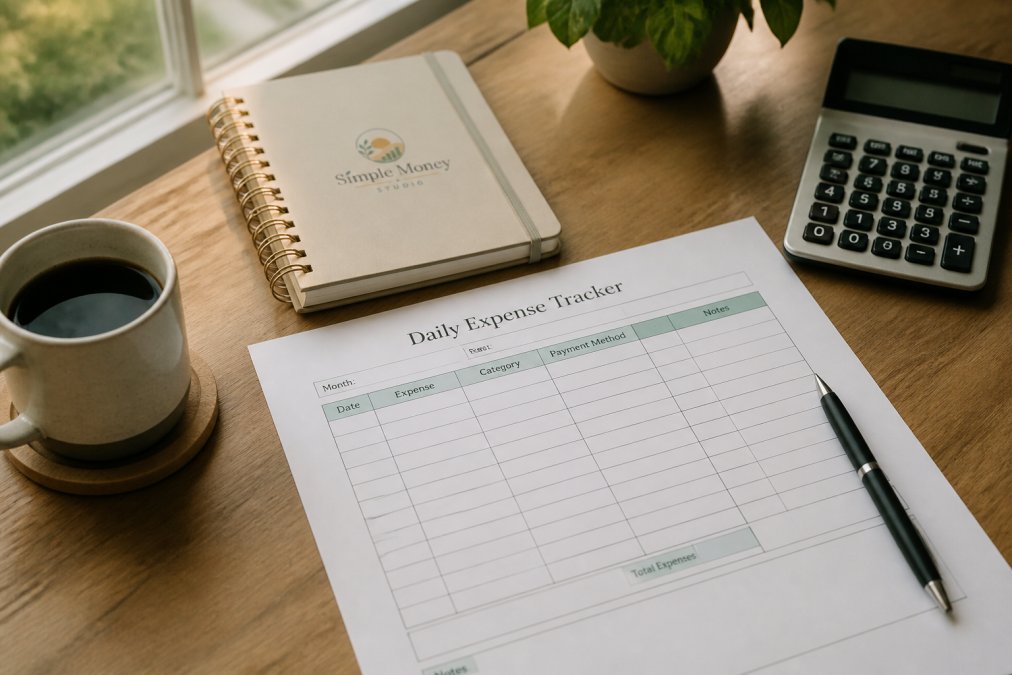
A daily spending log works best when each row answers three questions: what you bought, how much it cost, and which category it belongs to. Copy this format onto any notebook page or printed sheet:
- Date: 09/28
- Item: Groceries (weekly run)
- Amount: $84.20
- Category: Food
- Payment method: Debit
- Notes: Went over by $10, adjust next week
Best Practices for Expense Tracking That Actually Work
Effective expense tracking follows four rules: track daily, review weekly, categorize simply, and never let a missed day become a missed month. The rules only work if you connect the paper record to the money moving through your bank account.
- Write it down the same day. Memory reconstructs purchases badly by week's end. A purchase you can't recall precisely can't be categorized accurately.
- Review weekly, not monthly. Catching an overspend on Friday lets you fix it before month's end. A monthly review only tells you what happened; a weekly review changes what happens next.
- Keep categories broad. Five to eight beat twenty. Keep fixed expenses like rent and insurance separate from variable ones like groceries and entertainment. If a category has fewer than three entries a month, fold it into a broader one.
- Give every dollar a job. Money not assigned to bills, spending, or savings tends to disappear. This is zero-based budgeting, and it works on paper or in an app.
The psychology behind the habit
Tracking fails for behavioral reasons, not mathematical ones. A few patterns explain most of it:
- The friction gap. Opening an app, logging in, and navigating to a screen takes more steps than writing a number on a sheet on the counter. Higher friction kills the habit faster. Paper wins because it's already in front of you.
- Emotional spending triggers. Stress, boredom, celebration, and social pressure drive unplanned purchases. Writing the purchase down, and noting the trigger in a "notes" column, turns the log into a record of why you spent, not just what. Over a month, most people spot two or three recurring triggers they didn't know they had.
- The what-the-hell effect. One overspend often leads to abandoning the whole month. Fix it with a rule decided in advance: when you go over a category, write it down without judgment and adjust the next week, not the whole month.
- Awareness precedes change. Awareness of spending is the first step toward changing it, and awareness requires a record. The record doesn't have to be perfect to be useful.
Bridging paper and digital banking
The strongest setup combines both. Your bank and card statements already contain every transaction, categorized by merchant. Use them to check your paper log, not replace it:
- Weekly reconciliation. Once a week, compare your bank and card activity for the past seven days to your daily log. Anything on the statement but not in the log is a missed entry; anything in the log but not on the statement is cash. Ten minutes catches the small purchases that slip through.
- Download the CSV. Most banks export transactions as a CSV. Paste the amounts into a spreadsheet, sort by category, and get a monthly total without retyping. The paper log does the daily work; the export does the monthly math.
- Use alerts as a backstop. Set a low-dollar alert on your card so every transaction triggers a notification. The alert isn't the tracker, it's the reminder that a purchase needs writing down.
- Keep the paper log as the source of truth for cash. Cash purchases never appear on a statement, so the daily sheet is the only place they exist. That's one reason a paper log earns its place even for people who bank entirely online.
How to Customize Your Printable for Your Life Stage
The same template works differently depending on your stage. A new graduate tracking a first paycheck needs different categories than a family managing shared bills, and a freelancer needs a structure no standard worksheet provides. Treat each starting point below as a baseline you edit, not a finished plan.
Students and first jobs
Keep the category list short: income, rent or dorm costs, groceries, transportation, phone, and one flexible "fun" line. The goal isn't precision, it's building the daily habit while fixed costs are low. Add one savings line and fund it with whatever's left after flexible categories, even if small.
Families with shared bills
Use two layers. One organizer page holds household bills, rent or mortgage, utilities, insurance, childcare, groceries, and each adult keeps a separate daily log for personal spending. Reconcile weekly so shared bills are checked off in one place and personal spending stays private.
Debt repayment
Add a dedicated debt line to your daily log and a monthly page listing each balance, its minimum payment, and the amount owed. Update balances monthly to see the total falling. The daily log tells you what you spent; the debt page tells you whether the plan is working.
Freelancers and self-employed workers
This is where a generic printable breaks down. If you file a Schedule C, some expenses are business deductions, and mixing them with personal spending costs you at tax time. Split your tracker clearly:
- Business expenses: software subscriptions, home office supplies, mileage, contractor payments, business insurance, professional development.
- Personal expenses: everything else.
Retirees and fixed-income households
Shift emphasis from earning to drawdown. Track income sources separately, Social Security, pension, retirement account withdrawals, and watch the withdrawal rate rather than the daily total. A daily log still helps, but the weekly review matters more, since a fixed income leaves less room to absorb an overspend later in the month.
Irregular income
If your income varies, don't build a budget around your best month. Use your lowest reliable month as the baseline and treat anything above it as a bonus for savings or debt. This is the most common mistake people with variable income make.
Accessibility and inclusive design
Most printable trackers are designed for average vision and steady handwriting. If that's not you, the format is the problem, not the template. A few adjustments make almost any tracker usable:
- Large print: enlarge the PDF to 125-150% before printing, or use legal-size paper so rows stay wide while text grows.
- High contrast: print black on white or use a bold font; avoid light gray gridlines that vanish under low vision.
- Fillable PDFs for limited dexterity: typing entries removes the handwriting barrier and keeps a clean digital copy.
- Screen-reader-friendly versions: a tagged, fillable PDF can be read aloud by common assistive tools; a scanned or image-based printable cannot.
- Simplified layouts: fewer columns and larger cells reduce cognitive load for anyone managing attention or memory challenges.
Frequently Asked Questions
What is the best way to track daily expenses?
The best method is the one you will actually use consistently. For many people, a simple daily expense tracker printable works better than an app because it sits on your desk or fridge where you see it. Write down each purchase as it happens in categories like groceries, gas, and eating out. Review the log weekly to spot patterns. The goal is not perfect record-keeping; it is awareness of where your money goes so you can adjust.
How do I create a simple daily expense tracker?
Start with a sheet of paper or a printable template divided into columns: date, description, category, and amount. Add a running total column if you want to see cumulative spending. Print 30 copies for the month, or use a fillable PDF if you prefer typing. Keep it somewhere visible. Each evening, spend two minutes logging the day's purchases. Simple Money Studio's 1-Hour Budget Setup Guide includes printable worksheets that pair well with a daily log.
Are printable expense trackers effective for budgeting?
Yes, for many people they are more effective than apps because they remove friction and notifications. Printables also work offline and do not require subscriptions. The key is consistency: fill it out daily, review weekly, and adjust your budget monthly based on what you see.
What should be included in a daily expense log?
A useful daily spending log example includes the date, a short description of the purchase, the category (such as groceries, transportation, or entertainment), and the amount. Add columns for payment method and whether it was a need or a want. Some people also track their mood or trigger to understand the psychology of spending. At the bottom, include a daily total and a running monthly total so you can see how small purchases add up.
How can I track my spending without an app?
Use a paper-based system: a printable daily expense tracker, a small notebook, or a envelope system with cash. Write down every purchase as it happens. At the end of each week, total your spending by category. Compare that to your budget. Adjust as needed. Many people find that the physical act of writing makes them more mindful. Simple Money Studio's Money & Bills Organizer is designed for this hands-on approach and includes a custom tracker page for irregular expenses.