

Table of Contents
- Step 1: Gather Every Household Bill and Statement
- Step 2: Build a Central Bill-Paying Station
- Step 3: Set Up a Monthly Bill Tracker
- Step 4: Create a Bill Payment Calendar
- Step 5: Try Organizing Bills in a Binder
- How to Keep Track of Bills and Due Dates Every Month
- Privacy, Security, and When to Shred Old Documents
- Irregular Bills, Shared Households, and Late Payments
- A System You'll Actually Keep
- Frequently Asked Questions
Last Updated: October 6, 2026
Step 1: Gather Every Household Bill and Statement
Learning how to organize household bills starts with one move: collect everything first. You cannot sort what you cannot see.
Grab a box and walk through your home: kitchen counter, entryway pile, car, email inbox, and app notifications.
Aim for 60 days of paperwork, enough to see what a normal month looks like.
Sort Bills Into Fixed, Variable, and Annual Piles
Now separate everything into three piles.
- Fixed bills: Same amount every month. Rent, mortgage, insurance, phone plan.
- Variable bills: Amount changes each month. Electric, water, gas, credit cards.
- Annual bills: Once or twice a year. Car registration, taxes, membership renewals.
Variable and annual bills are where late payments sneak in, because they never land on the same date or amount.
Step 2: Build a Central Bill-Paying Station
A bill-paying station is one fixed spot where every bill, pen, stamp, and folder lives.
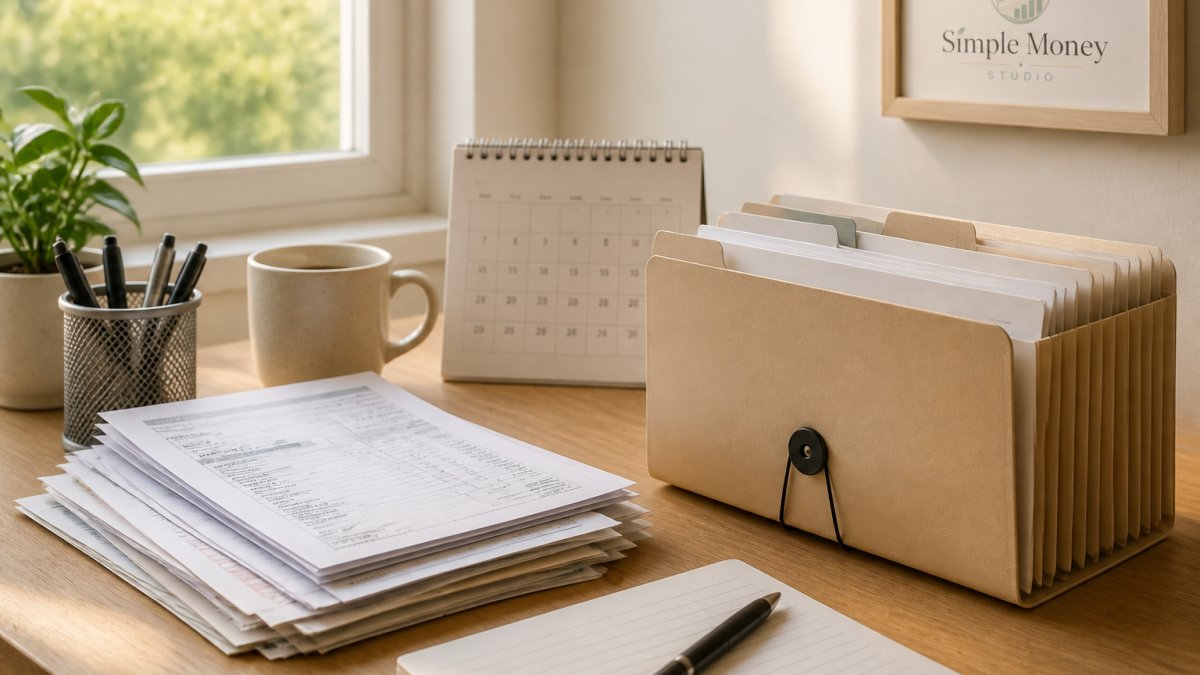
You don't need a home office, a corner of the kitchen table or a tray on a shelf works.
Set up your station with a few basics:
- A folder or tray labeled "To Pay"
- A second folder labeled "Paid"
- A pen and a small notepad for notes
Keep it small. A station that takes up too much space gets cleared away, and forgotten.
Step 3: Set Up a Monthly Bill Tracker
A monthly bill tracker is a single page listing every bill, its due date, the amount, and whether it's paid. It replaces the mental checklist running in your head all month.
Build one in a spreadsheet or on a printable page. Many people find paper easier because it sits where they can see it.
What a Good Tracker Page Includes
A tracker that works has six fields. Skip one and something slips through.
| Field | What It Tracks | Why It Matters |
|---|---|---|
| Bill name | Who you pay | Stops duplicate or missed accounts |
| Due date | When it's owed | Prevents late fees |
| Amount due | What you owe | Flags changes month to month |
| Amount paid | What you sent | Confirms nothing was skipped |
| Date paid | When you paid it | Gives you a paper trail |
| Notes | Autopay, confirmation number | Helps when something goes wrong |
Our Money & Bills Organizer was built around exactly this layout. It tracks income, bills due, bills paid, and bills still due on one page, plus a weekly check-in routine and an annual bills section so yearly charges stop being surprises.

Step 4: Create a Bill Payment Calendar
A bill payment calendar spreads your due dates across the month so they don't all hit in the same week. That single change does more for your cash flow than almost anything else.
Here's how to build one in a few minutes:
- Write down every due date from your tracker.
- Mark each one on a monthly calendar.
- Circle any date where two or more bills land together.
- Call those companies and ask to move a due date. Many will shift it.
Most bills cluster in the first and last week of the month. Spreading them out means each paycheck covers a share instead of one check taking the whole hit.
Step 5: Try Organizing Bills in a Binder
Organizing bills in a binder gives you one place to store paper records, the method we recommend for anyone who likes seeing things on paper.
Set up your binder with one tab per category:
- Housing (rent or mortgage, utilities)
- Insurance (auto, home, health)
- Debt (credit cards, loans)
Punch holes in paid bills and file them behind the right tab. At year's end, move the stack to a storage box and start fresh.
The 1-Hour Budget Setup Guide pairs well with a binder.

How to Keep Track of Bills and Due Dates Every Month
Knowing how to keep track of bills and due dates comes down to one habit: a short weekly check-in. Daily tracking burns people out. Monthly tracking is too late.
Pick the same day and time each week, Sunday evening works for most households, and set a phone reminder.
The 5-Minute Weekly Check-In
Run through this list once a week, about five minutes.
- Open your tracker and check what's due in the next seven days
- Log anything you paid since the last check-in
- Open new bills and file them in the "To Pay" folder
Five minutes a week replaces the low-grade worry of not knowing where you stand.
Privacy, Security, and When to Shred Old Documents
Bills carry account numbers, your address, and sometimes your Social Security number. Treat paper and digital copies like cash: know how long to keep each record, where to store it, and how to destroy it.
How Long to Keep Each Type of Bill
Different records serve different purposes, so a practical schedule looks like this:
| Record type | Keep for | Why |
|---|---|---|
| Monthly utility, phone, and internet bills | 1 year | Useful for disputing charges and spotting rate creep; rarely needed after that |
| Credit card and bank statements | 1 year, or until your year-end review | Needed if you are audited, applying for a loan, or disputing a charge |
| Paid receipts for major purchases | As long as you own the item | Warranty and insurance claims |
| Loan payoff letters and mortgage closing documents | Permanently | Proof you no longer owe the debt |
| Tax returns and supporting records | At least 3 years, longer if you filed a claim or underreported income | The IRS generally has three years to assess additional tax, and longer in specific situations |
| Medical bills | 1 year, or until insurance resolves the claim | Coordination-of-benefits disputes can resurface |
Rule of thumb: if the bill proves you paid something you might need to prove again, keep it. If it only confirms a routine monthly charge, a year is plenty.
Where to Store Sensitive Paper
A binder on an open shelf is fine for a paid receipt, but not for a document with your full account number or Social Security number. Split storage into two tiers:
- Working tier: the current-year binder or tray on your desk. Routine bills only.
- Locked tier: a locking file box, a locked drawer, or a small fire-resistant safe for tax returns, loan documents, birth certificates, and anything with a Social Security number.
If you have roommates, frequent visitors, or a cleaning service, the locked tier is not optional. A locking file box costs less than a month of most utility bills and removes the easiest path to identity theft at home.
A Paper-and-Digital Workflow That Actually Works
Most households run two systems that never talk: a paper pile on the counter and a login screen for every provider. Pick one home for each bill and route everything else to it.
- Choose a primary format per bill. For bills you rarely dispute (streaming, phone), go paperless and let the provider email you. For bills you might need to reference (medical, insurance, taxes), keep paper or download the PDF to a labeled folder.
- Use one email folder. Create a folder called "Bills" and a filter that routes every statement notification into it. That single folder becomes your digital "To Pay" tray.
-
Download, don't just read. When a statement arrives by email, download the PDF to a folder named by year (for example,
2026 Bills). Email accounts get closed, hacked, or locked; a local folder does not. - Back up the folder. A cloud drive or an external drive, updated monthly, protects you if your computer fails.
- Shred the paper once the digital copy is confirmed. Do not keep both unless the paper version is the legal original.
How to Shred and Dispose Safely
A strip-cut shredder leaves ribbons that can be reassembled; a cross-cut or micro-cut shredder turns documents into confetti and is the standard for anything with an account number.
Before you shred, check whether the document is the only copy of something you might need. When in doubt, scan it first, then shred.
Protecting Digital Bills
Digital statements are only as safe as the account they live in. Three habits cover most of the risk:
- Unique passwords. Reusing a password across a bank and a retailer means one breach exposes both. A password manager makes unique passwords practical.
- Two-factor authentication. Turn it on for every financial account. A code sent to your phone stops most account takeovers even if your password leaks.
- Review autopay and linked accounts monthly. A closed card or changed bank account can cause a silent failed payment that you only discover when a late fee appears.
Paperless billing removes one exposure path (your mailbox) but adds another (your inbox and provider logins). The workflow above handles both.
Irregular Bills, Shared Households, and Late Payments
A monthly due-date list assumes every bill arrives on schedule, every paycheck is the same size, and one person handles everything. None of that holds for most households. This section covers variable income, shared leases, and bills you cannot pay this month.
Handling Irregular, Annual, and Variable Bills
The bills that cause the most damage are the ones that don't show up every month.
Annual and semi-annual bills. Car registration, property taxes, insurance premiums, licenses, and renewals.
Quarterly bills. Water, sewer, and some trash services bill every three months.
Seasonal bills. Heating and cooling costs swing hard.
Variable bills. Electric, gas, and credit cards change monthly. Log each payment to see the trend.
Shared Households: Assign Ownership, Not Just Tasks
The failure mode in a shared household isn't laziness, it's ambiguity. Two people each assume the other paid the electric bill, and neither finds out until the shutoff notice.
Fix it with three rules:
- One owner per bill. Every bill on the tracker has exactly one name next to it. That person is responsible for paying it or for confirming it was paid, even if the money comes from a joint account.
- One shared tracker. Both people can see the same list. A shared spreadsheet, a shared notes app, or a paper tracker on the fridge all work. What does not work is two private lists.
- A weekly handoff. At the same five-minute check-in, each person confirms what they paid. This is the step that catches the "I thought you did it" gap before it becomes a late fee.
For roommates, add a fourth rule: keep utilities in one person's name and have others reimburse on a fixed date, or use a bill-splitting app so the payment trail is visible.
When a Bill Is Late
A late bill is a phone call problem, not a website problem. Call the provider before paying online and ask three questions:
- Can the late fee be waived? (First-time waivers are common.)
- Can the due date be moved to a better spot in the month?
- Can the account be put on a short payment arrangement?
Get the name of the person you spoke with and a confirmation number, and write both in your tracker's notes field. If the arrangement isn't honored later, that note is your proof.
When You Cannot Afford a Bill This Month
Prioritize in this order:
- Housing (rent or mortgage)
- Utilities (especially anything that affects heat, water, or safety)
- Food and medical needs
- Insurance (a lapse can cost far more than the premium)
- Everything else
For the last group, call before the due date, not after. Most providers would rather set up a short plan than send an account to collections. Ask about hardship programs, budget billing, and assistance funds from the provider or your state utility commission, many exist and go unused because people don't know to ask.
Building a Buffer for the Months That Go Wrong
Once the system runs, aim for a one-month buffer: enough set aside to cover next month's bills before the month starts. Start with one utility bill and add to it each payday. A buffer turns a bad month from a crisis into an inconvenience.
A System You'll Actually Keep
The hard part of bill organization isn't the setup. It's the third week, when the novelty wears off and the pile starts growing again.
That's why we keep everything on paper. A tracker you can see on the counter gets used.
If you want a head start, the Money & Bills Organizer gives you the tracker page, bill calendar, payment log, and weekly check-in in one printable workbook.
Get started with Simple Money Studio and turn bill season from a source of dread into a routine you barely think about.
Frequently Asked Questions
How can I keep track of household bills and due dates without an app?
Use a paper system with three parts: a monthly bill tracker that lists each bill, its due date, and its payment status; a bill payment calendar that marks due dates on the days they fall; and a central bill-paying station where mail lands. Write due dates on the calendar the day a statement arrives, then check the tracker during a short weekly review. This keeps everything visible without opening an app or remembering logins.
Should I organize bills digitally or in a binder?
Many households use both. Paper bills and statements go into a binder with tabs by category or month, which makes them easy to grab during a dispute or tax review. Digital copies, payment confirmations, and account statements live in labeled folders or your bank's online bill management. The binder handles what you need to touch; the digital side handles what you need to search. Pick one as your main system so nothing gets tracked twice.
How long should I keep household bills and statements?
Keep monthly statements for about a year, then shred them once you have confirmed there are no unresolved charges. Hold on to tax-related documents, such as mortgage interest or charitable donation records, for at least three years after you file. Keep loan payoff letters, warranty paperwork, and anything tied to a major purchase for as long as you own the item. Shred anything with an account number, Social Security number, or signature before it goes in the trash.
What should I do if a bill is late or I can't afford it this month?
Call the company before the due date passes, not after. Most utilities, lenders, and service providers have hardship or payment plan options, and asking early usually keeps a late fee off your account. Write down the representative's name, the date, and what you agreed to, then add the new date to your bill payment calendar. If money is short across several bills, list every due date and payment amount, cover housing, utilities, and food first, and contact the rest in order of late-fee size.